
La Junta Criminal History Checks
A La Junta record check works best when it follows the record from its source. The police bureau keeps incident and arrest reports. The municipal clerk handles city-code, qualifying traffic, and municipal misdemeanor citations. Otero Combined Court holds state misdemeanor and felony case files. CBI compiles fingerprint-supported Colorado arrests and releasable dispositions, but it is not a substitute for those local files.
- Read the citation or paperwork and identify La Junta Municipal Court, Otero County Court, or District Court.
- Ask La Junta Police for the incident or arrest report, using the report number, date, and location when known.
- Contact the municipal clerk for a city citation and its final result.
- Use the Otero docket and records request for a state prosecution.
- Use CBI ICHC for fingerprint-supported statewide history, then verify each match with the originating office.
This five-source route prevents a dispatch call, booking allegation, and conviction from being treated as the same record. It also gives the requester a fallback when no local name-search portal exists.
La Junta Justice Geography
La Junta is both a city and the Otero County seat. That makes the record path unusually compact but still split by custodian. The municipal building serves city government and municipal court functions, while Otero Combined Court at 13 West Third Street holds County Court and District Court cases. A city police arrest may therefore produce a report at one office and a prosecution at another.
The distinction is legal, not just geographic. Municipal matters can remain with the city. State-law misdemeanors and felonies move into the county and district courts. Bent's Old Fort and the Arkansas River corridor explain La Junta's role as a regional junction, but neither is a records office. Search by the issuing agency and named court, not by a landmark or broad web result.
Records at La Junta Police
The La Junta Police Department Records Bureau maintains accident and arrest reports, releases vehicles, collects applicable fees, and answers records questions. The nonemergency and case-information number is 719-384-2525. Give staff the incident number when possible. A date, location, and the names tied to the event can help identify the right file.
The bureau may redact protected details. Juvenile, medical, victim, and active-investigation information does not become open merely because part of an event appears in a public log. Ask for a releasable report and clarify whether the request seeks an incident narrative, arrest report, accident report, or another item. Those are distinct products.
La Junta Police Bulletins
The official LJPD Bulletin page publishes monthly dispatch-call PDFs rather than a searchable arrest database. The listed call type may describe what dispatch first received, not what officers ultimately found. The city also withholds identifiers tied to juveniles, sexual assault, and medical calls under Colorado access rules.
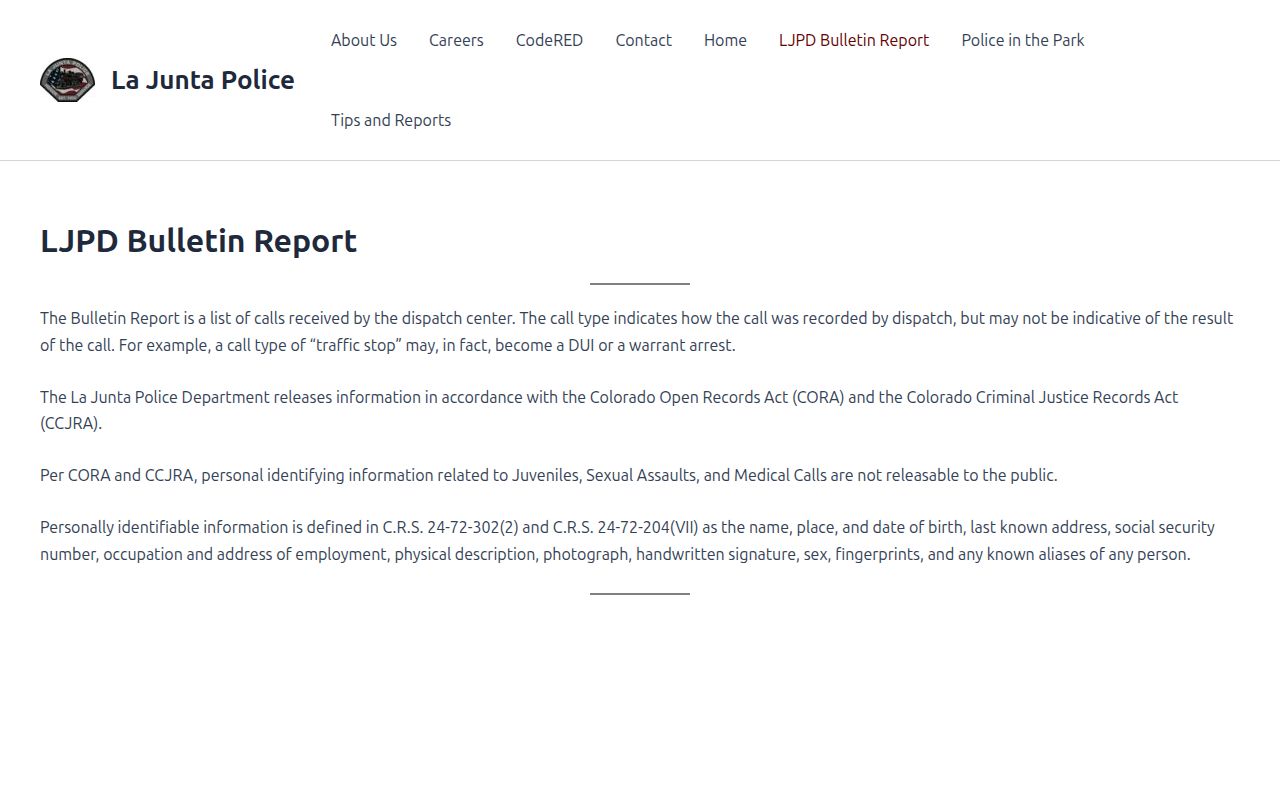
The bulletin image shows why a call entry should be used as a lead only. Request the underlying La Junta police record, then check the proper court for any filed charge and disposition.
Do not count calls as crimes or assume every call led to an arrest. A welfare check, suspicious-person call, traffic stop, report, and custodial arrest have different meanings. Monthly PDFs can help narrow a date, yet they cannot establish guilt or replace the case file.
Booking and Arrest Records in La Junta
La Junta Police creates the arrest report when its officers make the arrest. If the person is booked through the county system, jail staff create a separate intake record containing custody data, fingerprints, booking time, listed charges, and release or bond events that are releasable. Otero County does not publish an official public jail roster, so current custody requires the sheriff or jail contact route through the official county directory.
Ask who made the arrest, whether a booking occurred, the booking number, and the court tied to the charge. The police report explains the event. The booking file documents intake. Neither tells the final court result. For a deeper countywide explanation, the Otero County arrest search sets out the full fallback chain.
La Junta Arrests Reach CBI
Fingerprinting is the bridge between a La Junta booking and the Colorado Bureau of Investigation repository. CBI says its Internet Criminal History Check System contains Colorado arrest records supported by fingerprints and public disposition data. It excludes warrants, sealed records, and juvenile records. An unsupported-by-fingerprint arrest may not appear.
The flow takes time: arrest report › booking and fingerprints › prosecutor review › court filing and disposition › reporting to CBI. A recent La Junta event may exist locally before a statewide report reflects it. If CBI lacks a disposition, compare the result with the Otero court file and use CBI's challenge process for wrong or incomplete identity, charge, or disposition data.
The La Junta Municipal Court File
La Junta Municipal Court is at 601 Colorado and can be reached at 719-363-1246. Posted hours are Monday through Thursday, 8 a.m. to 5 p.m., and Friday, 8 a.m. to noon. It handles city ordinance, traffic, and municipal misdemeanor citations. It expressly does not handle Otero County Court summonses.
| Court Name | La Junta Municipal Court |
|---|---|
| Case Types Heard | City ordinance, qualifying traffic, and municipal misdemeanor citations |
| Case Lookup Channel | Clerk phone or counter; no public case-search portal |
| What the File Shows | Citation, appearances, orders, plea or trial result, and payment status where public |
| Copies & Fees | Confirm current copy charges with the clerk; Point & Pay is a ticket payment tool, not a docket search |
A missed appearance can lead to a bench warrant. Traffic defaults may add up to $45 and affect DMV status. A qualifying jury demand must be written and accompanied by a $25 fee within 25 days after first appearance. An eligible six-month traffic deferment can end in dismissal if all conditions are met.
La Junta Municipal or State Case
The fastest way to avoid the wrong counter is to read the court name on the paper. A La Junta ordinance citation belongs with Municipal Court. A County Court summons or state misdemeanor belongs with Otero County Court. A felony prosecution proceeds in Otero District Court. Police agency alone does not decide the court.
- Municipal citation
- A city-law or qualifying traffic matter heard by La Junta Municipal Court.
- CR case
- A Colorado criminal case number class commonly used for District Court criminal filings.
- Disposition
- The charge-level outcome, such as conviction, dismissal, acquittal, or deferred judgment.
- Bench warrant
- A court-issued warrant, often tied to failure to appear or obey an order.
Point & Pay requires a ticket number and processes payment. It does not reveal a complete court file. For Otero state cases, use the Judicial Branch docket and request documents from the clerk.
La Junta Offense Data in Context
FBI Crime Data Explorer data for La Junta Police, ORI CO0450100, show 35 violent and 455 property offenses in 2024 across twelve populated monthly series. The FBI agency population denominator was 6,942. These are offenses reported by one agency, not Otero County totals, convictions, calls for service, or unique people.
The figures help explain the volume behind local records, but they cannot answer what happened in one case. Confirm the reporting year and agency coverage in the FBI Crime Data Explorer. Use a police report and court disposition for a person-specific inquiry.
How La Junta Records Reach Otero
City and county records connect without merging into one file. La Junta Police owns its incident narrative. County jail staff own booking intake. The prosecutor selects filed charges. Otero Combined Court keeps hearings, pleadings, orders, and the final disposition. CBI compiles qualifying statewide history after agencies report the event.
Record flow: La Junta Police › Otero County Courts › Colorado Bureau of Investigation
For the actual state case, use the Otero Record/Document Request and provide the case number, party names, case type, and filing year when known. The form can request a complaint, disposition or sentence order, register of action, and certified copies. A daily docket is only a schedule, not the full record.
Correcting a La Junta Disposition
When an arrest is present but the outcome is missing or wrong, begin with the court that heard the charge. Obtain the signed disposition or sentence order from La Junta Municipal Court for a city case, or Otero Combined Court for a state case. Compare the name, date of birth, case number, charge, and final result against the police and CBI entries.
A court correction does not always update every downstream system at once. Keep the certified or clerk-issued order. If the CBI history remains wrong after processing time, use the CBI record challenge guidance. Record sealing is a separate legal process and begins in the court that handled the eligible case.
La Junta City Hall Records
The City of La Junta publishes its main municipal contact at 601 Colorado, La Junta, CO 81050, with the city number 719-384-5991. Posted municipal building hours are Monday through Thursday, 7:30 a.m. to 5 p.m., and Friday, 7:30 to 11:30 a.m. Police and court requests should still be routed to their proper custodians.
The city image anchors the municipal side of a La Junta record search. State prosecutions and county booking files remain outside the city clerk's case custody even though the offices sit in the same community.
La Junta Record Access Rules
Colorado separates general city records from criminal justice records. CORA governs many government records. CCJRA governs police incident, arrest, booking, and other criminal justice material. The custodian may redact private data, victim or juvenile details, medical information, and material whose release would harm an active investigation. Court files follow Judicial Branch rules and directives rather than a general request to city hall.
Key Statutes:
C.R.S. §§ 24-72-200.1 through 24-72-206 set Colorado Open Records Act access rules for covered public records.
C.R.S. §§ 24-72-301 through 24-72-309 govern inspection and release of criminal justice records.
C.R.S. §§ 24-72-701 through 24-72-710 address qualifying criminal record sealing routes.
Ask for a defined record, date range, and case or incident number. Public does not mean unredacted, and a denial or redaction should be assessed under the law that applies to that custodian.