
A sound search separates scope from delay. CBI compiles Colorado history, while an Otero County file covers one prosecution. Federal and out-of-state matters use other systems. Compare the arrest date, agency, fingerprint cycle, court number, filed counts, and disposition date. Those anchors show whether two entries describe the same event. Do not merge people merely because their names look alike.
When reviewing your own supervision record, begin with the sentence order. It helps distinguish probation from a prison term followed by parole. Contact the assigned probation officer when known and state whether a deadline is urgent. General callers should expect privacy limits because a public judgment does not open treatment plans, home addresses, risk assessments, or officer reports.
Crime data needs the same care. A La Junta Police count is not a county total, and sheriff figures omit events handled by city police, Colorado State Patrol, or another agency. Reporting participation can change from year to year. Keep the named agency, period, and coverage beside each number. A call for service is not always a crime, an arrest is not a conviction, and several offenses can arise from one event.
For police reports, send the request to the agency that created the file. La Junta Police, Rocky Ford Police, the Otero County Sheriff, and Colorado State Patrol maintain separate channels. State the incident date, location, report number, and requested parts. Ask whether photographs, recordings, supplements, or crash records must be ordered as separate products. A focused request helps the custodian estimate search and redaction costs.
Otero County Criminal History Checks
Choose the source by the question. The Colorado Judicial Branch docket search is the first stop for a filed Otero County case. CBI ICHC is the public statewide name check. The arresting agency owns its incident report, and the sheriff holds county booking material. CDOC, probation, and the registry each keep a separate status record. One search cannot replace all of them.
Gather the full legal name, date of birth, spelling variants, event date, city, agency, and any report or case number. Exact identifiers help separate people with similar names. They also cut clerk search time and may reduce fees.
- Decide whether the goal is a court outcome, arrest report, current custody fact, state history, or registry result.
- Search the official source with the strongest known identifiers.
- Read the record label and date before treating a result as a match.
- Request the underlying court file or agency report when the summary lacks context.
- For your own record, correct errors with the clerk, arresting agency, or CBI office that owns the data.
Four Otero County Record Systems
Otero County records move through four main layers. Law enforcement creates the incident and arrest file. Jail staff create booking and custody data. Otero Combined Court records the filed charge, hearings, disposition, and sentence. CBI compiles fingerprint-supported Colorado arrest and disposition cycles. CDOC becomes relevant only after a state correctional sentence.
| Official channel | Best use | Key limit |
|---|---|---|
| Arresting agency or sheriff | Incident, arrest, booking, and jail facts | Does not prove the filed charge or outcome |
| Otero Combined Court | Docket, pleadings, orders, disposition, sentence | One court case, not a statewide history |
| CBI ICHC | Publicly releasable Colorado history | No warrants, sealed cases, or juvenile records |
| CDOC Offender Search | State correctional custody or status | Not a county pretrial roster |
Official Background Checks in Colorado
The Colorado Bureau of Investigation, Biometric Identification and Records Unit, maintains the state repository. Its Internet Criminal History Check System permits a one-time name search without an account. It costs $6 for each downloaded matching result. More than one plausible match can create more than one charge. The result covers Colorado fingerprint-supported arrest records and releasable dispositions, not a full national file.
A fingerprint-based personal review offers stronger identity matching. CBI-approved Colorado Applicant Background Services vendors include IdentoGO and Colorado Fingerprinting. The CBI Colorado search charge is $16.50 plus the vendor capture fee. CBI also offers a $13 staff-processed name and date-of-birth CHRI route that may be notarized. The FBI Identity History Summary is a separate, subject-only federal product with an $18 FBI fee.
The CBI source page shows the one-time and account search paths.
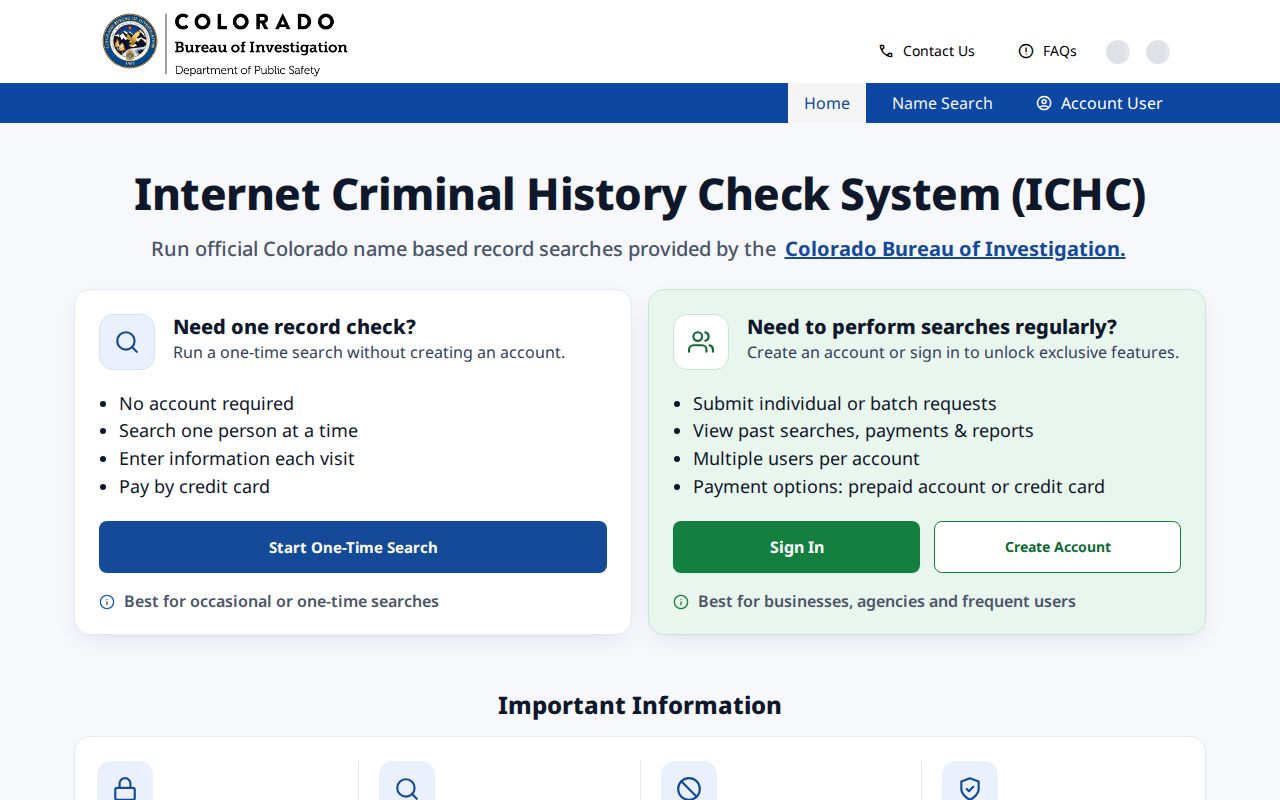
That screen marks the state repository layer, which should be checked against an Otero County court file when the final outcome matters.
The CBI Biometric Identification and Records Unit page explains the office behind the repository, fingerprint services, and record review process.
This agency page is the better starting point for fingerprint instructions or a challenge to an incomplete state history.
Otero County ICHC Search Limits
ICHC is name based. A common name, alias, spelling error, or arrest without supported fingerprints can produce uncertainty or no result. The public report omits warrants, sealed records, juvenile matters, and sex-offender information. A clear return therefore does not prove that no local report, out-of-state case, federal matter, warrant, or restricted record exists.
| Field | Use | Search note |
|---|---|---|
| Last and first name | Required name match | Use full legal spelling |
| Middle name | Narrows common names | Optional |
| Date of birth | Strong identity clue | Use exact date |
| Sex and race | Portal-dependent filters | Enter only when known |
| Social Security number | Optional secure identifier | Never guess or send by ordinary email |
The secure digital signature on a downloaded ICHC report helps show whether the file has been altered. It does not expand the report's legal scope.
Kinds of Otero County Criminal Records
Each record has a different author and purpose. Asking for the right item avoids a common problem: reading an early allegation as though it were the final judgment.
- Incident and arrest reports: the investigating agency records events, observations, and the basis for custody.
- Booking records: jail intake records identity, charges presented, fingerprints, bond, custody, and release events.
- Court case files: the clerk keeps pleadings, docket entries, orders, disposition, and sentence.
- Warrants: a court issues them and law enforcement records service; public ICHC excludes them.
- Supervision and registry files: probation, parole, CDOC, and CBI maintain distinct status data with access limits.
A criminal complaint or information is still an accusation. Only the charge-level disposition tells whether it ended in conviction, dismissal, acquittal, or another result.
Otero County Jail Record Fallback
No official public Otero County jail roster or booking-log portal was found. Do not replace it with an unofficial booking gallery. For current custody, use the official county directory to reach the Otero County Sheriff's Office or jail. Give the full name and date of birth. Ask for the booking number, booking date, charge list, bond, court, and current custody status.
For an older record, submit a narrow CCJRA request to the sheriff. State the event date, arresting agency, report number if known, desired delivery format, and a cost ceiling. Otero County publishes no stable sheriff records-desk address, direct number, lobby schedule, or fee table in the reviewed official material, so confirm each point before travel.
If the person later entered state custody, use CDOC rather than the county jail route. The official CDOC Offender Search illustrates that separate system.
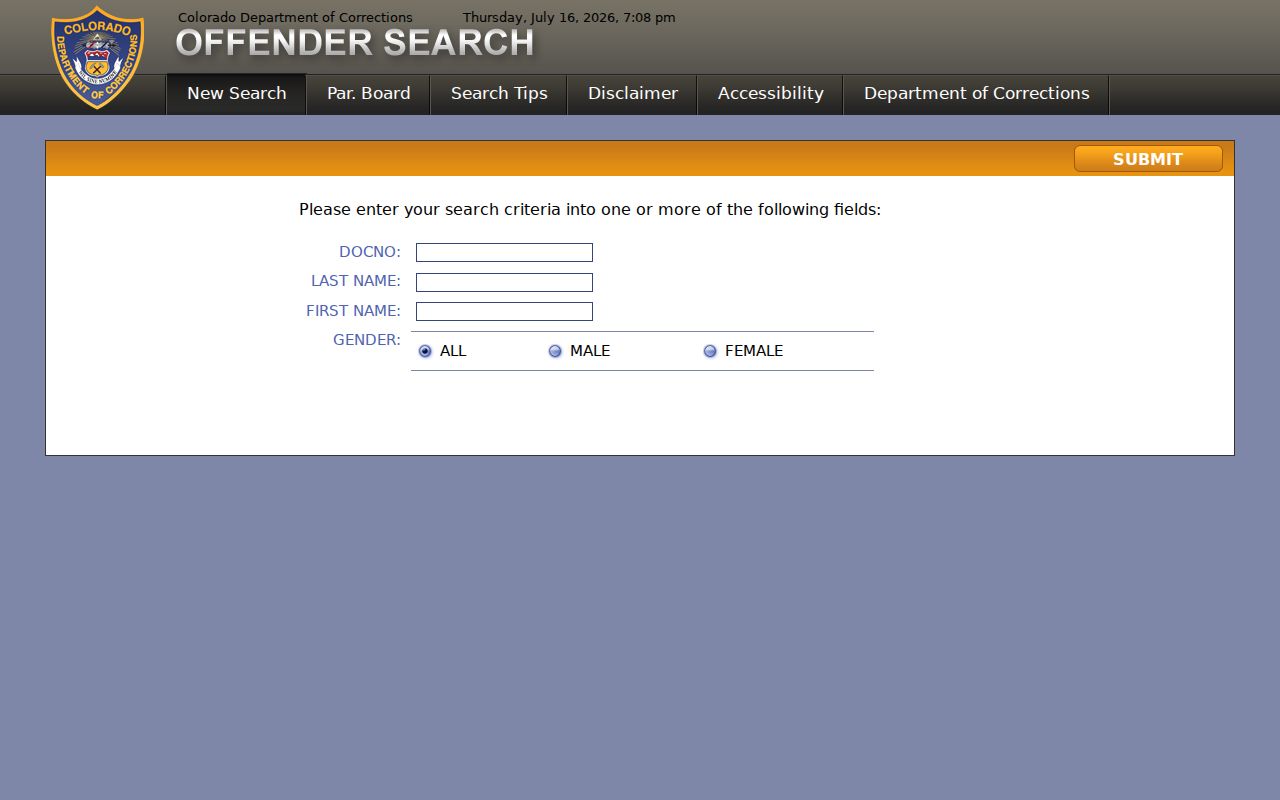
The CDOC form answers state correctional questions, not whether someone is now held before trial in Otero County.
Otero County Criminal Records: What They Contain
A complete Otero County record trail may contain identification, an arrest cycle, court data, and a custody or supervision result. Public versions suppress protected details. Compare the date, agency, case number, and disposition instead of relying on a name alone.
| Name & Identifiers | Names, aliases, date of birth, physical descriptors, state ID, FBI number, and fingerprint-linked identifiers where releasable. |
|---|---|
| Arrest / Booking Data | Arrest date and agency, report or booking number, intake charges, fingerprints, bond, and release status. |
| Charges & Statutes | Booking allegations and later prosecutor-filed counts, statutes, and offense classes. |
| Disposition | Conviction, dismissal, acquittal, deferred judgment, or another charge-level outcome. |
| Sentence | Custody, probation, restitution, fines, or other terms shown in the judgment. |
| Custody / Supervision | County custody, CDOC status, probation, or parole data, subject to access rules. |
Victim, child, medical, financial-account, and Social Security information may be redacted. An open docket does not make every filed document unrestricted.
Otero County Court and CBI Mismatches
The clerk and CBI can show different data because they maintain different products. A prosecutor may file a charge that differs from the booking label. A disposition may not yet have reached CBI, or it may fail to link to the fingerprint cycle. Begin with the Otero court's signed order when the case outcome is disputed.
Ask Otero Combined Court to verify the charge and disposition in its own file. If the clerk's file is correct but ICHC is incomplete, use CBI's record-challenge process. If the booking entry itself is wrong, contact the arresting agency or jail custodian. Keep copies of the order and request correspondence so each office can identify the exact record.
- Docket
- The dated list of filings, settings, and court acts.
- Disposition
- The way a charge or case ended.
- Deferred judgment
- A plea whose judgment is delayed under set terms and may later be withdrawn or dismissed when law allows.
- Sealing
- A court process that restricts ordinary public access without necessarily destroying every agency record.
Colorado Public Access Laws
Colorado uses both the Colorado Open Records Act and the Colorado Criminal Justice Records Act. Court records follow Judicial Branch rules and request procedures, while sheriff and police files are handled by the criminal-justice custodian. Public does not mean unredacted, free, or instantly available.
Key statutes:
C.R.S. § 24-72-203 sets general public-record inspection procedures and exceptions.
C.R.S. § 24-72-303 opens criminal-justice records of official action, subject to law.
C.R.S. § 24-72-305 governs discretionary access and protected criminal-justice records.
C.R.S. § 24-72-305.5 restricts specified direct-solicitation uses and permits a use statement.
C.R.S. § 24-72-306 authorizes reasonable copy, search, retrieval, and redaction costs.
Send the request to the office that made or holds the record. A general county request does not replace the Judicial Branch court form.
Otero County Warrant Check Route
CBI ICHC does not show warrants, and no official Otero County public warrant search was located. A person checking their own possible warrant should call the court named in the paperwork. Otero Combined Court can be reached at 719-384-4951. A city ordinance case may require the La Junta, Rocky Ford, or Fowler municipal court instead.
Ask for the case number, issuing court, warrant status, and appearance instructions. The sheriff may explain its process for executable warrants, though staff can limit what is said by phone. A docket may show a failure-to-appear event, but it is not a full active-warrant database. Restricted CCIC and NCIC entries are not public name searches.
Restricted, Sealed & Expunged Records
Record sealing is Colorado's main adult remedy. Expungement chiefly describes qualifying juvenile relief. Sealed matters leave ordinary public ICHC and court search, though authorized access may remain. Juvenile files, victim and minor identifiers, medical facts, financial data, and protected addresses also receive special limits.
Start with the exact Otero County case and its final outcome. The Judicial Branch sealing page separates form sets for non-convictions, convictions, multiple cases, and juvenile expungement. Eligibility can depend on the disposition, offense, later history, restitution, and statutory category. File in the court that handled the case unless the selected form directs another route.
An order does not always update every system at once. After the court grants relief, follow its distribution steps, check the court view, then review CBI after processing time. Challenge an entry that remains wrong.
Otero County Probation and Parole
Probation is part of the Colorado Judicial Branch. The Sixteenth Judicial District Probation Department serves Otero, Bent, and Crowley counties, and publishes 719-384-5973 for La Junta and Rocky Ford. A judgment may state that probation was imposed and its length. Treatment, addresses, risk material, and officer reports may remain confidential.
Parole is different. The Colorado State Board of Parole makes release decisions, while CDOC administers adult parole and community supervision. CDOC search may show custody or status, but it is not an Otero County probation database. Trace probation through the court and district office; trace a prison or parole sentence through CDOC and Board sources.
Otero County Charge Pipeline
The arresting agency records the suspected event. The Sixteenth Judicial District Attorney then decides what state charge to file, if any. Felonies go to Otero District Court. Most state misdemeanors go to Otero County Court. Municipal code matters can remain with a city court. That handoff explains why the booking description and formal count may differ.
The Sixteenth Judicial District Attorney source identifies the prosecution office serving Otero, Bent, and Crowley counties.
The office's role begins after the event report and leads into the clerk's court file, where the public can confirm the filed charge and result.
Otero County Justice Context
Otero County sits in Colorado's Arkansas Valley. La Junta is the county seat and main records hub. Rocky Ford and Fowler keep their own local police or municipal channels, while state cases can move to the combined county courthouse in La Junta. This geography often explains why a city search ends with a county record request.
The 2023 Sixteenth Judicial District overview described a rural three-county system with two full-time district judges, one full-time magistrate, one part-time magistrate, and three part-time county judges. Fiscal year 2022 brought 1,315 district-court filings and 2,927 county-court filings across the whole district. Those are not Otero-only counts.
The Census QuickFacts source supplies current county context without mixing old district estimates into present population claims.
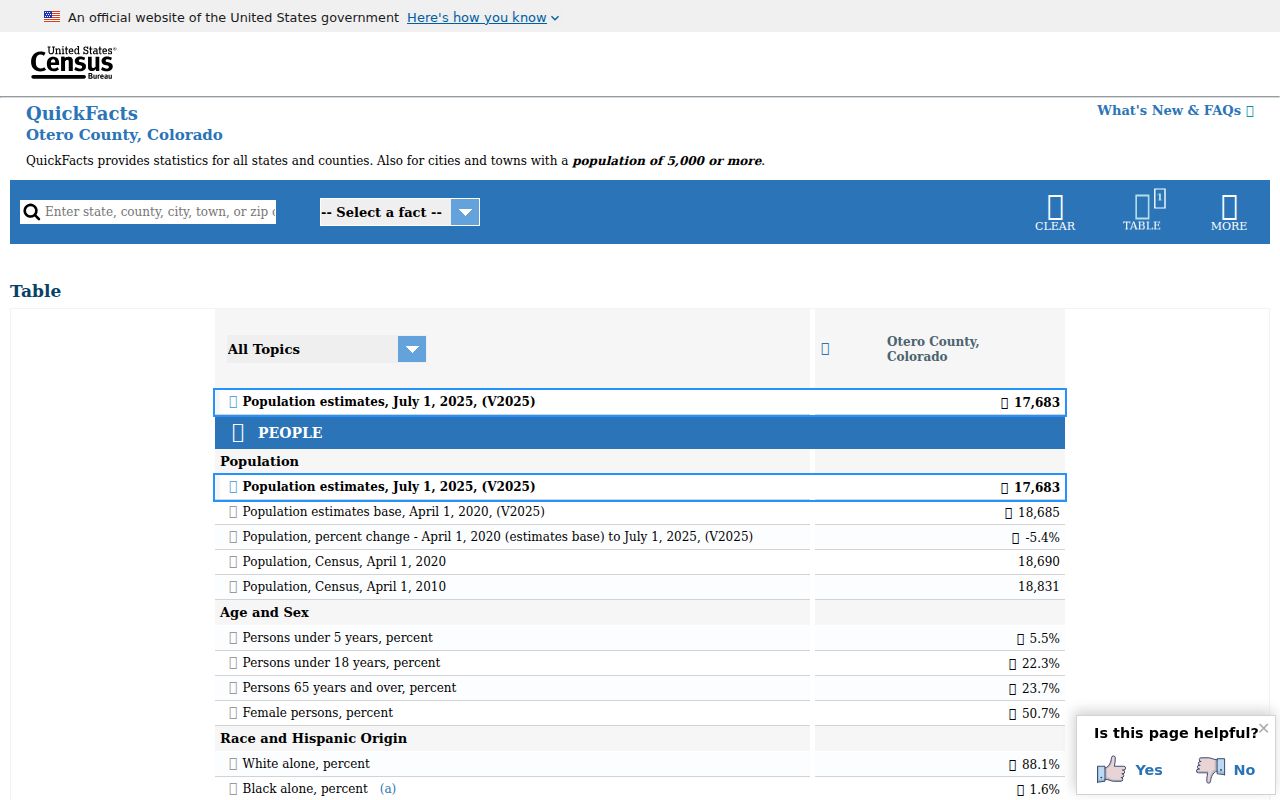
Population and crime figures should always retain their date, source, and geographic scope.
City-by-City Criminal Records in Otero County
City police reports and municipal files begin with the city that made the record. State-law cases may then move to Otero County or District Court. The three city guides match the county's top incorporated places using consistent 2020 Census counts.
La Junta Record Check
7,322 residents in the ranking source. City police and municipal court sit beside the county-seat record path.
Rocky Ford Record Check
3,876 residents. Police CCJRA requests and municipal cases use distinct city channels.
Fowler Record Check
1,253 residents. Call the named agency or court because no local case portal is published.